
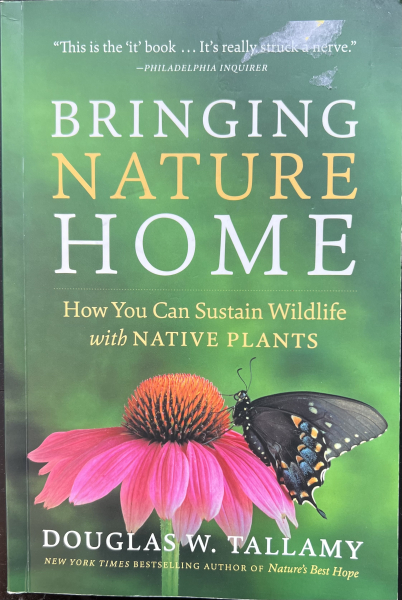
Bringing Nature Home: How You Can Sustain Wildlife with Native Plants by Douglas W. Tallamy. Timber Press, Portland, Oregon, 2007, updated in 2009. 360 pp. Paperback
How Can I Help? Saving Nature with Your Yard by Douglas W. Tallamy. Timber Press, Portland, Oregon, 2025. 376 pp. Hardcover
I might seem an unlikely fan of Doug Tallamy’s books. For decades I have been a plant collector of beautiful and unusual plants, without regard for their country of origin. I love my seed grown primulas, my Cercidiphyllum japonicum and Acer triflorum trees, my epimediums and Japanese anemones. I grow native woodland plants, but they are outnumbered by their Asian counterparts. My native pussy willows have been replaced by Japanese species and cultivars with rose and black colored catkins and curly willows of Asian origin.
I have been short-sighted. In Bringing Nature Home, Tallamy points out that in most of the United States, there are few places left for wildlife to exist. The populations of most insects, birds and other animals are declining rapidly, in large part due to the loss of habitat and the widespread use of pesticides. We have consigned the work of conservation to trained conservationists, readily leaving to them the problem of saving the planet. However, parks and nature preserves represent but a small fraction of the land needed to support our ecosystem.
The birds we love depend on insects (especially caterpillars) to live and raise their young, but most of our native insects cannot eat “alien” plants. Lawns are ecological deserts, supporting little life. Asian plants growing in our North American gardens are no better. But there is hope. By favoring native plants in our yards, each of us can help to sustain the biodiversity needed for a functioning ecosystem.
Bringing Nature Home is a very readable book and replete with beautiful photographs. If you read only one of Tallamy’s books, this is a good one to pick. Tallamy discusses habitat fragmentation, the importance of keystone species, why insects can’t eat alien plants, gardening for insect diversity, and how to include more natives in your landscape. The chapter on woody plants ranks these genera by how many species of moths and butterflies they support. The chapter titled “What Does Bird Food Look Like?” reviews all the families of insects that should be living in your yard. Tallamy’s background in entomology shines through with his detailed descriptions. The book concludes with lists of native plants with wildlife value and desirable landscaping attributes, sorted by region and plant type.
How Can I Help?, Tallamy’s most recent book, has an unusual format. This book contains Tallamy’s answers to 499 of the most-commonly asked questions that Tallamy has received over the years. The questions are sorted into chapters by topic, including Ecology and Evolution, Biodiversity, Native and Non-Native Plants, Oaks, Invasive Species, Pest Control, Conservation and Restoration, Home Landscapes, and Supporting Wildlife at Home. I enjoyed reading this book with its looser structure and deeper exploration of topics. Tallamy’s humor also comes through occasionally, as when someone asked how to make their yard more raptor friendly, and he noted that providing a bird feeder for small birds will help.
A few of the fun facts I learned from this book: ecologically speaking, moths are much more important than butterflies. They are better pollinators and outnumber butterfly species 19 to 1 (pp 36). Most oaks are planted by blue jays (p. 82). Two species of European chrysomelid leaf beetles that are host-specific to purple loosestrife have achieved excellent to total control in most loosestrife infestations where the beetles have been released (p 174). Use yellow bulbs instead of white ones in outdoor lights, to avoid luring moths to their deaths (p 322). European honeybees compete with native bees, to the detriment of native bees (p 334).
I have enjoyed these books and recommend them whole-heartedly. I look forward to the evolution of my own garden into a habitat.
Deborah Banks maintains a large garden in the northern Catskill foothills above Oneonta, NY.